Sunday, August 22, 2010

Tires, Incan Ruins, the Environment, and…more Dancing!

Yes, I am still here, alive, active and living by the seat of my pants as always. The week before last was a week full of me learning and re-learning the lesson that I am not in control and plans are often just really exercises for the brain but futile if intended to help in directing how reality will play out. Because I’m working half-time at two different places and am also involved in this tire-composting project, I never really know exactly how my day will turn out and often I find myself pleasantly surprised. So different from my lifestyle back in Virginia.

As I promised in the last blog that I would explain more about the composting, I will start with that. My friend, Renee is working on her thesis project which involves reducing, reutilizing and classifying waste in a neighborhood of the southern zone of Cochabamba. I, along with a Maryknoll priest “Pablo” (a South Dakotan who went to the same college as my grandpa) are helping her. We collect tires, of which there are thousands along the highway, side roads and neighborhoods just looking trashy, so we salvage them to make a composter.

 
We fill them with our kitchen waste (except meat, bones, fat, dairy) and garden waste, top it with two tire rings tied together with a mesh screen in between to keep out/in the flies. Every couple weeks I flip it upside down by pulling each tire and its contents off the stack one by one, shoveling the material back in that tire which instead of being on top is now on bottom etc. That way, it gets air, which helps in decomposition. Tires are great because they maintain the heat, don’t let out moisture, are durable, free and we’re re-using.

 
In the past couple months, we have given 3 workshops to both little kids and teenagers/young adults, and it’s possible that the Boy and Girl Scouts will take it on as a national project this upcoming year (although that hasn’t been decided yet). I’ve got two here in the garden at the social center where I live and one I’m taking care of in front of the Justice and Peace office, where I work part-time.

I’ve been really surprised by the interest people have in it. Most people I talk to actually like the idea and are very encouraging. The other day I went to an inter-institutional meeting of groups working with the people who search through garbage to find recyclables (they hardly earn any money and are a very poor group) and found out that studies done in Cochabamba show that 50-60% of the average person’s trash here is organic, and 22-25% is recyclable. Trash is a really big issue here and I think possible solutions or strategies are attractive for that reason.

When we went to work with the after-school group in a neighborhood of the southern zone, we took them on a scavenger hunt to find materials and they loved it! They were so enthusiastic about assembling it when we got back as you can see in the pictures. Here we are with some of the kids of the afterschool program.

 
Tires are also great for making planters and when painted, look much better.

 
I keep talking about the "southern zone" which is hard to describe in words without pictures to help, so here are two photos to give more of an idea of the conditions (like lack of water) that the people living there are dealing with.


Shortly after these pictures were taken, I went to a national gathering of the Franciscan movement of Justice and Peace in a town about 45 min. from here, called Tarata. I somehow got put on a committee of the Franciscan Justice and Peace group of Cochabamba (there are groups in most of the 9 departments of Bolivia). I wasn’t feeling great that week, but I was able to enjoy the beautiful garden at the Franciscan convent we stayed at, very aware of the stark contrast with the southern zone pictured above.

 
I also want to share a giant painting I saw there, with the title “Andean Face of God”. I realize everyone has different viewpoints of God or whether a God even exists, but I really like this painting because it expands the traditional western image of a white old guy. I think there’s no way to ever *fully* define God; that would be too limiting. My experience has shown me that God can be found in every person and in "mother earth" too. Whatever you think, I hope at least you find it thought-provoking.

 
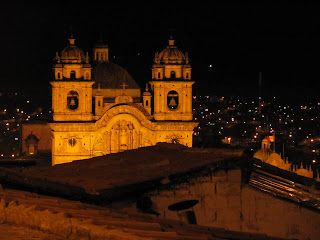
Circumstances turned out that July brought an opportunity to go to Cusco, Peru, where I met up with my sister’s boyfriend, who was doing some civil engineering work with a group of archaeologists from UCLA at Saqsaywaman, a famous Incan ruin. I had an incredible time seeing LOTS of ruins and terraces, beautiful hiking in the Sacred Valley and Cusco Valley, multiple museums, and great food and drink including ceviche…mmmm! Luke and I made good travel buddies because he was patient with my very long teeth-brushing and sun-screening routines and I was patient (well maybe a little cranky at times) with his simple and non-costly diet of bread and peanut butter we had every day. I really enjoyed having a personal guide, or at least one who had books and was willing to go on adventures. (picture below is of Compañía de Jesús, Jesuit church in Plaza de Armas)
 
On Friday, 23rd of July we took a taxi up to Tambomachay (ceremonial stone bath), then walked to Puca Pucara (fort or hunting lodge on a private Incan estate), photo below

 
After Puca Pucara, we continued along the hills to a mystery ruin, Salapunco (temple of the moon with really cool carvings and views), Q’enqo (zigzag large limestone rock with niches and stone altar), Saqsaywaman (“greatest and most superb edifice raised by Incas to demonstrate majesty and power” with three levels of terraces separated by giant stone zigzag walls), three photos below


I couldn't help myself, all those stone walls were just asking to be tested out

 
After spenging a good while exploring the obvious beauties of Saqsaywaman, we kept going on to the archaeology dig back in the very quiet and beautiful “campo”, and finally after 10 hours of exploring-walking to a restaurant with a delicious meal I scarffed down without barely a breath.

Saturday was museum day and we got stoned-out (as in, rocks, not other substances)—those Incans were INCREDIBLE. I just don’t know how they possibly formed the stones so perfectly and placed them as high as they did nor as perfectly. Very impressive, and my engineer expert felt the same way. We saw some incredible churches too, one with tons of mirrors all over, giving it a magical sparkling effect that was entrancing (Santa Clara).

Sunday we went to the cathedral—wow, that was huge and full of very large stone columns and a painting of the Last Supper, complete with guinea pig and chicha (fermented corn drink). Even though Luke had cold sweats, we still took a day trip out to the Sacred Valley to visit Moray and Salinas. Moray is thought to have been an archaeological experiment with terraces in a funnel shape to a depth of 150 meters.

 
Salinas – So. Much. Salt! We talked with a pre-teen girl working there with her little baby sister on her back. She explained that she walks 2 hours to get to the Salinas and each plot is owned by a family. Families usually have multiple plots. The salt was just so beautiful, like snow, but not cold and not as soft and fluffy. She said there’s a legend that a saint came here and spilled his chicha down the valley, which is why all the salt appeared here.

 
Monday we headed to Pisaq, 32 km from Cusco. 4km from (mostly up) the pueblo are archaeological ruins and more terraces than you can imagine. It was such a great hike with beautiful sights and lots of awe-moments. The trek became especially memorable because poor Luke revealed part-way through that he was actually feeling pretty bad, but was an amazing sport and pushed through—thanks Luke!

 
Immediately after returning, I jumped back into a project I was leading a group of 5 high-school students in, from the San Carlos center Cerro Verde. They researched how global warming is effecting the flora and fauna of Brazil and presented the their findings at a conference where other high school groups presented about other countries and other affects such as health and water. It was a good learning experience, both for me and for them. They’d never used powerpoint before, nor had much experience presenting in front of a large group of peers, so I did lots of encouraging and reassuring!

 
Speaking of the environment and gas emissions that have a greenhouse effect, here is a picture I took from the hill of Cerro Verde, overlooking the city of Cochabamba. Without any rain, the smog just hovers

 
Here are two little friends of mine at Cerro Verde, photo taken courtesy of another kid anxious to practice his photography skills.

 
Sunday August 8th the neighborhood of Cerro Verde ended a week of celebration with a parade, mass and large lunch feast. There were two dances, the Saya, an afro-bolivian dance, and the morenada, another folkloric dance. Here are two photos of the girls dancing the Saya


These little kids were dancing the morenada...How cute are they? Check out the link below for videos of the dances.

 
I will end by sharing a link to a newspaper article from the NY Times article about the city I live in, Cochabamba, Bolivia “All Advice leads to Cochabamba”. Clearly, a good place to visit, not just because I’m here and promise to be a wonderful host! http://frugaltraveler.blogs.nytimes.com/2010/06/29/all-advice-leads-to-cochabamba-bolivia/

Next entry will not come so late, and I’ll talk more about all the experiences I’m having with the kids at Cerro Verde, guinea pigs, Franciscans International-Bolivia, and my beloved composters and plants. Also, the festival of “Virgen de Urkupina” was just celebrated and I have stories about that too – complete with dances and another overnight walk. Thanks for being patient with me.

For more pictures and videos, please go to http://picasaweb.google.com/nora.pfeiffer/Aug16Blog#

5 things I’m thankful for today: talking to my cousin; homemade pizza; sharing pictures of my friends, family, and the North Carolina beach with the kids who live here in the center with me; a day of rest; and a hilarious video-card I received from a friend of a very confident and positive little girl, Jessica, singing on her bathroom counter…what great spirit!

Tuesday, July 6, 2010

Dancing, Sunrises and the Changes they accompany

As I type this, I’m letting my laundry soak and listening to the clinking and sawing of the construction workers across the street, loud motorcycles speedily driving by, and the echoes of kids in the passageway. It was already three weeks ago that I finished language school and shortly thereafter moved out of my host family’s house into an apartment with another from the FMS group, Clare. Our apartment is in an old beautiful convent that was donated by a group of Franciscan sisters about 3 years ago to be used by the Franciscan family to help those more in need of space.


It’s called the Franciscan Social Center and it’s located right in the center of town. There’s a dentist; psychologist; social worker; ear, nose and throat doctor; physical therapists; AA, NA and Al-Anon groups; weekly meal offered to people on the street; and a non-profit for kids who are recovering from very severe burns and live here in the center. Needless to say, we’re never alone and there’s always kids asking us to play or go wherever we’re going. It’s a beautiful apartment and we did what any logical person with lots of space and little furniture would do – we had a party! It was grand, complete with cueca, tinku, morenada, chacarera, salsa, merengue and Michael Jackson.


Backing up a couple weeks to the last day of the 5 month language course, we had quite a day to celebrate the transition. First there was a ceremony/liturgy in which we were all presented with t-shirts and certificates and “sent” out. Everyone (17 students) gave a “despedida” farewell speech, in Spanish of course. Afterwards the real fun began—the talent show! For lack of anyone else volunteering, I ended up being the MC of the talent show and figured all that would involve would be introducing each act, but I was wrong. One of my teachers told me that the MC always has to bide time by doing something, so I researched in the Spanish version of Reader’s Digest for jokes and told many a corny joke in Spanish, which was just about as funny as it is in English. Luckily, the audience was kind. (This is a picture of me introducing the next act, wearing my tinku outfit)


My favorite parts of the talent show were the dances. I participated in a chacarera and a tinku, of which I have videos on-line. We also did a skit making fun of ourselves and all the mistakes we’ve made over the course of the 5 months. After the talent show there was a big bbq lunch and after that a live band and more professional dancing by a group of high-school students. Because they were so good, I took pictures and videos of them as well. Once the professionals finished, the dance floor opened up to everyone and we had a grand ol’ time. I’ve noticed that Bolivians like to dance in circles holding hands or in two lines facing each other, and that is what we did.

 
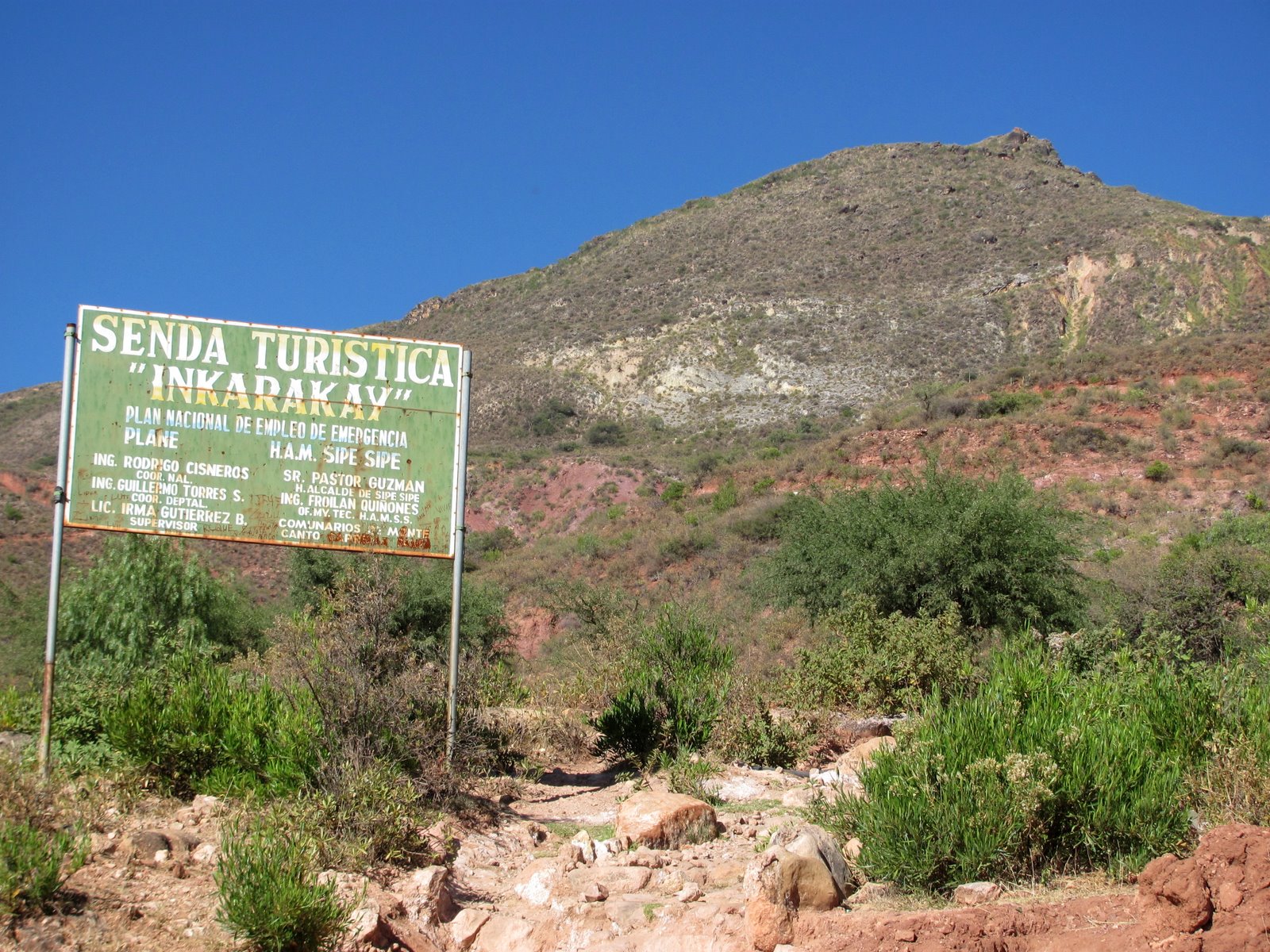
A week after moving out of my host family’s house and into the apartment, I went with a group of people to hike Inkarakay, a mountain in Sipe Sipe, for the Winter Solstice, which marks the New Year for the Amayra people. We took a bus to Sipe Sipe on Sunday night June 20th. At about 11pm we started walking up the mountain. Along the way we stopped to listen and dance to a group of men playing music on the side of the road. About half way up the mountain, we stopped to build a fire from brush we could find around the area. The stars were incredible and once the moon set after 2am or so, we could REALLY see the Milky Way in all its glory. It got very cold so the fire was much appreciated, although everyone had the same idea so the air was sadly quite polluted.


We made it up to the top around 5:30am to join thousands of other people waiting for the sunrise. Many had brought tents and camped out but we took the no-sleeping route of hiking during the night, which I enjoyed a lot. It’s amazing what great conversations come about when hiking, as well as seeing the world through the different lens of darkness, separated from accustomed electricity. To help keep up our stamina and to participate with the tradition, we chewed coca leaves, which helped a lot. In order to receive coca, one should put out both hands as a sign of respect. Also, I’ve noticed that if you have coca and someone else does, you both exchange some leaves when you greet the other person—it’s that reciprocity value coming up again.

Right before the sun came out, everyone woke up and we stood together, cold and waiting, but together. As soon as that first ray appeared over the mountain across the Cochabamba valley, we all put our hands up to greet the sun.


Because the 21st of June is the shortest day of the year here in the southern hemisphere, the Amayrans view it as the return of the sun because the days are now getting longer. It also dictates a new agricultural season. Three llamas were sacrificed at sunrise as a sign of thanks for both the sun and the earth. People got some of the blood to put on their cheeks as well as little bits of wool. I really love sunrises and it was a good experience to share it with so many, who were also so thankful for the gift of the sun and all that it gives to us.


The next morning, on Tuesday the 22nd of June, I participated in a march that the mayor’s office was sponsoring to bring more awareness about the pollution that inevitably comes every year with the Feast of San Juan (June 24th) but celebrated by the majority on Wednesday night the 23rd with fires outside, hot dogs, hot drinks, and fireworks. It was really incredible to see how much fire and smoke there was all throughout the city and into the country areas surrounding the city. While normally I can see the northern mountains of the valley out my window, I could not see them AT ALL the next days. People told me it was better than in the past, but still pretty bad. Some people also set fires in a park nearby and lots of trees were burned, which made me sad. I like that having a “campfire” brings people together and the warmth is very comforting, but the negative effects of almost everyone doing it is discouraging…I feel conflicted.

Another area I’ve been feeling unsure about over the past several months is what I’m going to be doing and where exactly I’ll be after language school. I have more interests than time or energy would allow me to invest myself in, but I have managed to narrow down to two areas, which I will try for three months and then reevaluate if they are in fact good fits. One is working with an NGO, Franciscans International, which has general status at the UN and centers its efforts around matters of justice, peace, the care of creation and the promotion of human rights, which is what St. Francis and St. Clare worked towards in their lifetimes as well. I’ll be helping out with FI-Bolivia, concentrating on issues around ecology. There’s a lot going on here, but few people speak English, which makes it difficult to communicate at the international table, so I hope to help with that. Also, I will be helping to spur more interest within the Franciscan family here around caring for creation, which includes education at schools, churches etc.

The second ministry I’ll be involved in is working with a church called San Carlos, which is located in a part of the cancha (the huge market area of town) and has 5 separate centers throughout the southern zone in poor neighborhoods. At these centers there is after-school help, lunches, classes for kids and adults, sports etc. I’m meeting with the people in charge on Wednesday July 7th, so I’ll be able to write more about that next time. Oh, and forgot to mention that I’m also helping out a Bolivian university student, who is doing her thesis project in a poor neighborhood in the southern zone around minimizing and sorting trash, recycling, and composting. A Maryknoll priest and I are helping her to build composters out of tires in order to make lovely rich dirt in the middle of this dry dessert climate, so that people can grow wonderful food and plants, while cutting down on their trash by about 50%. I’m having a lot of fun with it, and I’ll be sure to share my pictures and more details about it next time.

5 Things I’m thankful for today: tea kettle we just bought that doesn’t produce gray flakes on the bottom like the other one did; enough money to be able to buy food and things like a dustpan, tea kettle and pressure cooker; my new plant passed on to me by a friend who is leaving; playing wiffle ball on July 4th; my stomach feels better today than it did yesterday and I am so happy for that!

For more pictures and the videos from the graduation (clausura)please go to : http://picasaweb.google.com/nora.pfeiffer/ClausuraBlog#
For more pictures of my hike to Ikarakay and the apartment, please go to: http://picasaweb.google.com/nora.pfeiffer/InkarakayHike#

Tuesday, June 22, 2010

Chapare, Tapacari and Feet

Heading east from the city of Cochabamba one finds the region of Chapare, which is a large rain-forest area in the Upper Amazon Basin. Cochabamba is dry and more desert-like than tropical, so the drastic change in the scenery on the drive there was surprising. It was incredibly humid when we stepped off our bus, which prompted those of us from the east coast of the US to exclaim with a mix of surprise, disappointment and nostalgia, “ewwww, this feels kind of like home in the summer time!”

 
The town our hotel was in is called Villa Tunari, which at one time was the hot-spot for narco-traffickers, but has changed into the central location to bring in tourists. On Saturday we visited a coca farmer; tried to visit the FELCN (Fuerza Especial de la Lucha contra el Carcotráfico) the Bolivian anti-narcotics forces; Parque Machia which is an animal reserve; and went out to dinner to enjoy some delicious fish. On Sunday we went to a national park called Parque Nacional Carrasco and a trout farm for lunch on our way back to Cochabamba.

Before describing the visit in more detail, I’d like to talk about coca. Before coming here, I didn’t know what the coca plant looked like, smelled like or what it could be used for besides cocaine. Since being here, I have discovered there is a whole lot more to coca than that. For ages and ages, the coca leaf has played a very important role in the Andean cultures. For example, it gives strength and demonstrates honor and respect by exchanging it with another person. Bolivia has a history of exploitation especially in her rich mines. The colonists recruited indigenous people to work in the mines, usually staying down for days at a time. I can’t imagine what that would be like but I’m sure I’d get hungry and tired pretty quickly. In order to help them keep up their energy and suppress their grumbling tummies, the miners constantly chewed coca.

Coca can be used to make a tea, which is the way I usually consume it. It’s great for altitude adjustment, digestive problems and upset stomachs especially. It can also be made into flour, candy, baked goods, juice etc. The coca plant can be harvested up to 4 times a year and has a life of 10-20 years. It’s extremely light to transport and grows very easily in sub-tropical regions. There is a coca union here, so after the farmer harvests it, the coca is brought to a central location where it is processed and put on the market. According to what I was told, it is sold at the same price for legal and illegal purposes.

The use of coca for cocaine really only started here in the 1970’s when General Banzer was dictator, as I understand the story. In 2004, the Bolivian government made an agreement with the Six Federations of the Chapare coca farmers to set the legal limit of coca growth per person to one “cato” which is 1600 square meters. With this amount of land, farmers can earn about US$1000-1200 per year from coca (according to Andean Information Network). See picture below of one cato just harvested.

 
This cato of coca is owned by a farmer we were able to visit and talk with. He also grows cocoa plants, rubber trees, palms to get heart of palms, and black pepper. He talked about his story and how awful it was when coca started to be used for the wrong reasons. It came as a real shock to him when it happened. He doesn’t want to stop growing it because it’s more lucrative than other crops, it’s able to be harvested repeatedly and it’s easy to transport, which is a big deal for farmers in the midst of poor roads in Chapare. Below is a picture of the farmer's rubber trees.


After visiting the cocalera (coca farmer) we attempted to visit the FELCN (Fuerza Especial de la Lucha Contra el Narcotráfico) the Bolivian anti-narcotics forces station, but they changed a ceremony’s location so we weren’t able to. On the drive back, we went past a training school where Bolivians are trained in anti-narcotic efforts in rural jungle regions. I was told that while in school, every person’s name is taken away and they are called “elements” and that many people who are a part of the leadership and teachers there were trained in Fort Benning, GA at WHINSEC (formerly known as the School of Americas).

 
We took a break from the subject of coca in the afternoon to go to Parque Machia, which is a private reserve for monkeys, macaws and pumas, although we didn’t get to see the puma. They say that the animals are saved from captivity, but I also read that they’re the animals misplaced from their homes by construction of roads or commercial interests. Therefore, I’m not sure why exactly the animals are there, but it enabled me to have an up-close-and-personal encounter with several monkeys!

 
When we arrived, some monkeys were sitting in the park volunteers’ laps or hanging out in the trees. They started to climb onto us visitors and inspect people’s hair and pockets. I decided that I wanted to go see the macaws so I started walking down the path when all of a sudden a mama monkey with her baby hanging on to her front crawled up my legs and onto my back. Not 3 seconds later, another monkey jumped on my head. I stood still with tense shoulders, not really knowing what to do because there weren’t any park volunteers around me. After a little while, I started walking and once I got to a railing all 3 decided to hop off.

I was warned that these monkeys were very forward and you shouldn’t take any jewelry with you or anything in your pockets because they will take it. For this reason I didn’t bring a camera but some of my friends risked it and so I have some pictures from them to share.

 
The next day we got up and went to the ecological park, Parque Nacional Carrasco, which was probably my favorite part of the trip. The park protects about 6,200 km. of multiple ecosystems on the slopes of the Andes, including high grasslands, cloudforests, and tropical rainforests, as low as 300m and up to 4,000m. There are over 700 species of birds and lots of awesome animals like jaguar, tapir and peccary. The big threats are illegal logging, hunting and deforestation for agriculture by people along the northern and southern borders of the park. There are people who live in the parkland and we came across someone’s cato (plot of coca) while on our walk.

 
To enter the part of the park where we spent most of our time, we crossed a river in a little cart. We walked for a couple hours through the jungle and it was just beautiful, beautiful! There were tons of plants, trees with crazy roots, butterflies, leaf-cutter ants, bats, funny flowers, caves and even more than my imagination could handle. At one point we walked up into part of a semi-cave, from which was coming a loud rackety noise. Turns out the noise was coming from birds, which I think were guacharós, oil birds. They’re nocturnal, eat fruit, make clicking sounds in order to navigate and are found in few places of S. America. Again, amazing how MUCH biodiversity there is in such a small country.


A few days after returning from Chapare, some friends invited me to go on a day trip to Tapacari, about 3 hours drive from Cochabamba. Here are Jenna and I at a self-made rest stop on the way there. No restroom stall at a rest stop in the states has this good of a view!

 
In Tapacari there is a small village that didn’t used to have water, but now does because of a project that lasted for over a year to transport it from 15 km up the way. Jason, who is a civil engineer and a Maryknoll missioner, lived out there for about a year helping with the project. All the manual labor was done voluntarily by local people. They now get water but Jason thinks there were a couple kinks in the original planning and they could be getting more water than they are. When I asked how the people felt, he said they were and are grateful to have water but were also disappointed that the output was not what they were told to expect.

 
Above is the peninsula and at the tip is where the pueblo is. At the top of the picture, is about where the source of water is, about 15 km. After hanging out in the plaza so Jason could catch up with old friends, we ate lunch and were joined by a little girl who had her dress on backwards, no underwear but was the cutest and most diligent teacher of quechua to my friend Minh.

 
We then drove up to the stream that gives water to the town. This is a suspension bridge, which is holding the piping to transport the water. Jason said the villagers carried all the parts on their backs up this very steep and slippery hill we climbed so that I could take this picture...I have no clue how they did that because I had to use both hands to grab on to the plants in order not to fall backwards.

 
Going up we got some pretty incredible views as well. I really enjoyed the day and it was good to be somewhere out of the city.


There was one moment that struck me especially. As we were in the plaza, a group of three people arrived carrying large loads in their aguayos (large pieces of colorful cloth). As they took them off their backs with sighs of relief and set them on the ground next to their feet, my eyes stopped. Their feet. They were wearing sandals made of tire rubber and yet the skin of their feet didn’t really look like skin anymore, it had been so weathered; it was as if I was looking at a clay sculpture of feet. The next day I was out in a restaurant of Cochabamba and looked down the line of people sitting at a table next to us…all very nice, very pretty shoes and feet (mine included). Incredible. These two images are very vivid in my mind and I think about them a lot.

I’m ready. I’m ready to enter more into the lives of those tough, weathered yet very strong feet; that is, if they’ll have me. There is goodness and wisdom in each person and I hope that I can continue to build friendships with Bolivians of many different paths, those well-paved as well as those a little rougher to travel. It’s a hopeful future I’m looking at as I leave language school and start trying to find my place here in Cochabamba, Bolivia.

For pictures of my trip to Chapare, please click on this link
http://picasaweb.google.com/nora.pfeiffer/ChapareBlog#
For pictures of my trip to Tapacari, please click on this link
http://picasaweb.google.com/nora.pfeiffer/TapacariTrip#

5 Things I’m thankful for: lush green tropical forests; fresh fish; postcards from friends; a little girl with sandals that squeaked and lit up with each waddle-step she took…oh that was funny; I have a place to sleep at night and it’s surprisingly warmer than my host-family’s house.