Monday, May 31, 2010

Toro Toro

Dinosaur tracks. Condors. Waterfalls. Rock paintings. Caverns. These are just some of the highlights I encountered when I went to visit Bolivia’s smallest national park in Toro Toro. Bolivia continues to amaze me with its wonders and beauties. I’m so grateful I got to go visit this area, which is about 130 km south of Cochabamba or a 5 hour bumpy ride.

 
The first day we found a guide in this very small town and he took us to see the first of many dinosaur tracks, Toro Toro Canyon and my favorite, the waterfall Vergel. The guide had little toy dinosaurs to demonstrate which ones left which prints. I’m not sure what the names are but the first ones we saw were of a 4-legged herbivore.


The prints were on this hill, which we were told was originally flatter but the earth has shifted a lot over time so the slabs were pushed up to more of a diagonal. I wished I knew geography better because looking at the mountains/hills, it’s clear that a lot has happened over time to change the landscape, but I don’t quite understand how, why or when it happened.

We also saw prints from a dinosaur with 3 fingers/toes that had wings and it would put its 2 wing points/hands on the ground and then lift its feet up and swing or hop forward. Some tracks were inverted in the ground and the guide explained that has happening because they stepped in mud and after it hardened was overturned somehow and yet maintained its original footprint form. We were having a ball getting in or very close to the prints, pretending we were dinosaurs or their prey, thinking we’ve got to enjoy this while we’re here because there are so many other things to see. Little did we know that we would continue to come across dinosaur prints in multiple places throughout our journey.

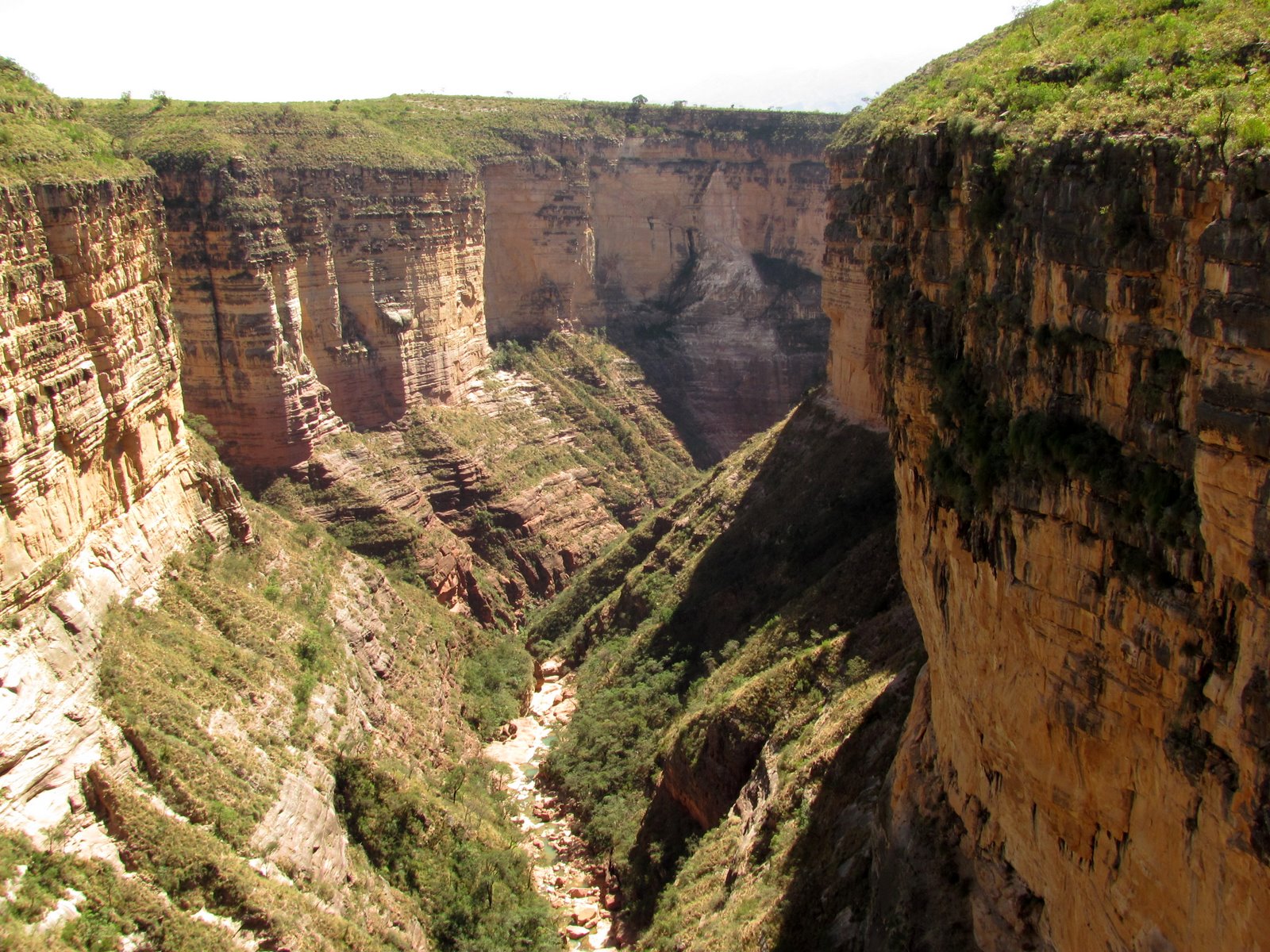
To continue on to the canyon we walked along a road and then a dried-out river or stream bed. At one point we came across a herd of goats all by themselves and they started jumping off the cliff at the sight of us…well, not really a cliff, but a small jump. Then, what seemed like out of nowhere we were at the edge of this canyon, whose expanse and depth surprised me. There were two condors swooping around at the opposite end from us, but other than them and us, it appeared to be rather deserted, which made it all the more beautiful.

 
After a mandarin break, we hiked down into the canyon to the waterfalls and swimming holes, where we ate lunch and played in the water. The 10 meter high waterfall is called El Vergel in Spanish, but in Quechua, it’s called Waca Senq’a, which means the cow’s nose. Can you tell by the picture why they call it that?

 
Green water plants and names aside, I thought it was gorgeous! The water was very refreshing and cold, but nonetheless irresistible.

 
I had a blast. The hike back up the canyon and to town took up the rest of our sun-light hours, so we could prepare for the next even fuller day’s activities.

The morning began by hopping into the back of a truck that would take us to the Ciudad de Itas caves and the Umajallanta caverns. The road was not paved (to say the least) and at some parts extremely soft so it took several hours to get there with all the getting stuck, but it was worth it. Several times we came across shepherds or shepherdesses and their flocks of either goats or sheep and their very protective sheep-dogs.

 
If I remember correctly, Itas, in Quechua means a type of bug, which apparently inhabited this place in mass numbers back in the day. We walked along what seemed like gigantic turtle’s backs made out of stone, down, up, down, up again more rocks to see the different “rooms” of this ciudad or “city”. One room was like a cathedral, but all made naturally. It was beautiful and even had a roof with “sky-lights”. We also saw some rock paintings that have lasted over time.

 
After eating lunch on the top of the ciudad, we headed back to the truck and drove down to our final adventure, the Umajallanta caverns. Between the spot to park the truck we came across more dinosaur tracks, this time of the ferocious T-Rex!

 
The ever-changing and enchanting geography was also a major highlight. For example, there were large plates of what used to be cracked mud and over time have become these beautifully designed slabs of stone that also got turned on an angle with the moving of the earth. Simple yet beautiful.

As we arrived at the large mouth of the caverns and it kept getting darker and darker, I knew we were in for a good adventure. The only lights inside the caves were our headlamps or flashlights and there were no railings or nice flight of stairs. Every now and then there were some metal rods to descend as a ladder but we mostly used ropes, our limbs, stomachs and our bums to slide, crawl, and climb through the caves. It was NOTHING like Lurray Caverns in VA, in the sense that you were just right in there with everything. I had to remind myself that it was ok to touch things, aside from the growing stalactites of course. We saw blind fish, little ponds, streams, stalactites and stalagmites including a stalactite tree and hollow stalactites. Only 7 km of caverns have been explored so far but it continues on and no one knows where they end…pretty amazing.

 
Posted by Picasa

The more I experience parts of Bolivia like Toro Toro, the more amazed I am at the earth we get to live on. It’s pretty remarkable. If you’d like to see more pictures, please go to
http://picasaweb.google.com/nora.pfeiffer/TorotoroBlog#

For a little video of my musical debut in the caverns, click on
http://picasaweb.google.com/nora.pfeiffer/ToroToroPics#5473733119050953842

5 Things I’m thankful for: the treat of eating delicious fish; my safety and health; reading a good book; dancing a tinku (folkloric fighting dance of Potosi) to celebrate Mother’s Day here in Bolivia this past Thursday May 27; getting to talk with family and friends.

Monday, May 10, 2010

Trash, Climate Conference and Peru

Happy Monday! Before I get into the climate conference and my trip to Peru, I want to go back to the issue of trash here in Cochabamba and some responses I got from that blog entry. I agree that we need to have a place to put our waste and if I implied that all dumps are bad ideas, I didn’t intend to. I agree that we should not feel guilty for doing what we need to do live, such as preparing food and inevitably having waste from that. I don’t feel guilty about having waste, but I do think it’s good to question how much waste I produce, whether it’s all necessary, how is it affecting others and whether I could use some of my waste in another form, such as putting food waste into compost instead of the trash? It’s not guilt that motivates my questioning, rather a hope of continual betterment for myself and my community whom I belong to.

I’m so appreciative of being questioned how racism is a part of the issue when I did not explicitly address the race and ethnicity of the people in the southern zone. I want to say first, I am in the beginning of grasping who the players are and what the history is, so I admit to my lack of experience and knowledge about this situation. In the midst of trying to gather more perspectives and background, I will attempt to put some of the pieces together, fully knowing it is incomplete.

From what I’ve listened to so far, I’m reminded just how much race is socially constructed and my ideas of the indicators of difference continue to be twisted, multiplied and turned around. How I’m thinking of racism is *systematically* assigning value based on race, which can be made up of different factors: biological/genetic, geographic, color of skin etc. From what I understand (which again, is not a whole lot as of yet) people in the southern zone come from other parts of Bolivia and from the country in hopes of getting more opportunity to earn a living.

Many are indigenous and may not know Spanish or if they do, it may not have been their first language; many have not been raised in the city; many work very long hours and get their kids to work too. People from less colonized areas tend to have less Spanish blood mixed in their lines of heritage and therefore tend to have darker complexions. To demonstrate how value is being assigned to complexions, most advertisements I see are of very thin lighter-skinned people with lighter hair and lighter eyes AND they sell beauty creams here for the purpose of lightening the color of your skin…all sending the message that you’re more beautiful and more valuable if you have lighter skin.

When the group of people who live in the southern zone don’t have their own water, have more sicknesses due to the dump, and live in much poorer conditions than the group of people in power of making decisions, it appears to me that the group of people in the southern zone are not seen as being as valuable as other people in Cochabamba. That is why I said that environmental racism appears to me, to be present here. I have so much to learn still and I may come back in several months or a year with a whole new perspective, but this is what I’m observing at this point in time, which doesn’t make it truth, simply my perspective.

 
On to the climate conference, officially titled People’s World Conference on Climate Change and the Rights of Mother Earth. After the UN met in Copenhagen in December 2009, many people were disappointed with the outcomes for the environment. Evo Morales, the President of Bolivia, invited everyone interested in the world to talk about the causes and solutions relating to the environmental problems. The idea was to include people who weren’t able to sit at the table of discussion in Copenhagen and have more dialogue on the following: structural causes of climate change; alternative models for Living Well in Harmony with Nature; talk about and agree on a Universal Declaration for the Rights of Mother Earth; plan a World Referendum on Climate Change; and come up with a proposal for a Climate Justice Court.

Because anyone could go, I signed up for free on the internet and I went to several different sessions as well as the closing ceremony on Thursday, Earth Day. There were lots of panels going on at the same time so I only went to some. Most panels/sessions took place at a university campus about 15 minutes from here. I didn’t understand everything because many hours on end is a lot to try to concentrate in another language, so content-wise I didn’t understand as much as I would have liked, but I’m glad I went. For example, I went to a talk about using local traditional knowledge and modern technology to help approach climate problems with farming in the Altiplano (higher altitude mountainous region) of Bolivia.

It was really fun to people-watch there because there were so many people there from all over Latin America especially. They reported that about 140 countries were represented. I met a guy from La Paz who works as a photographer in the Amazon and other national park areas of Bolivia. I met another guy from Argentina who was Hari Krishna and had a booth about vegetarian eating. There were lots of people there in indigenous clothing and it was very clear that we were a diverse group of people, just by listening and observing. I saw Miss Bolivia and the Vice President of Bolivia again, but not together this time. Small world.

 
The final day, the ceremony was in the soccer stadium in the city of Cochabamba and it was a lot of fun, although I found out later I left before all the REALLY good dance presentations started. All these different indigenous groups processed in, dancing and playing instruments. There were some performances and then a famous Bolivian band performed and they were great. Two people got up to read the findings of the 17 different working groups (each with its own theme), and plan for the future. The next meeting of this nature will take place in Mexico, at the end of this year I think. Next, the political leaders spoke, which was my least favorite part, but I stayed through it thinking they wouldn’t talk so long (I was mistaken). I never in my life expected to be in the same place as the Vice President of Cuba, Hugo Chavez of Venezuela, the VP of Bolivia and the President of Bolivia, Evo Morales. There was also a rep from Nicaragua. Granted, my comprehension and attention span were not superb, but it appeared to me that they were there for their own interests, not so much for the environment. Apparently after I left, things got a lot more jovial and celebratory, but I was leaving based on the time allotted in the program…silly me. It was a good experience and I’m glad I got to go. We’ll see what Mexico’s conference brings? You can see more pictures at http://picasaweb.google.com/nora.pfeiffer/ClimateConference#

 
Posted by Picasa
If you’re still reading, thank you! The last thing I want to relate is my trip to Peru last week. I arrived in La Paz about 6:15am to find out that there were blockades both in Bolivia and Peru on the roads to get to Puno. I asked four different people about it and got four different responses, until I heard one that cheered me up. I could still get across the border if I took a car or van, instead of a bus, which is exactly what I did. The road was bumpy, dusty and long but I got to the border. I got really lucky and the police boss let me go across without having to pay the standard 100 B’s even though my letter saying why I’m here in Bolivia wasn’t current enough for his liking, “just make sure every time in the future you get a new letter”…yes, sir.

I found a bus heading to Puno and what I thought would be 2 hours turned into 5. We got lost (which I realized later was because we were taking an alternative much longer route since there were blockades) and the driver suddenly had what seemed like 50 wives nagging him to pull over and ask for directions…c’mon, you’re wasting our time…ask him, ask him!!! It was pretty funny for me to listen to. We also got a flat tire and a police inspection. Finally we arrived in Puno and I was cold and wet, but found a market with some delicious food to fill my grumbling tummy.

I met up with my friends from Arizona, JP and Cathleen, who are living in Peru. It was so nice to see them again and we had a great visit. On Saturday we went on a boat tour in Lake Titicaca to visit some floating islands of the Uros people and then to a more solid island of Taquile. I learned that the Incans named the lake “Titicaca” because it looks like a puma chasing a rabbit...so they say, but you really have to use your imagination. Titicaca is roughly translated as “Stone Puma”.

 
Floating islands…what are those? They explained to us, using a model, that they transport hunks of earth out into the water and there they fasten them together to float. On top of this, they pile layers and layers (every 2 weeks) of this reed, called totora. The reeds are also used to construct their houses, boats and look-out towers. It appears that they really depend on tourists because everything was set up to invite us to spend money. I really liked their clothing – bright neon colors and it was interesting to see a glimpse of their lives.

 
Next we went further out into the lake and the sun finally came out for the first time once we arrived at the island Taquile. We had a great lunch and walked across the island to board our boat on the other side. The dirt was so brown and rich-looking, not what I see in Cochabamba. A lot of the day was spent on the water, which was fine by me because I absolutely love being on the water. With no oceans to go to, at least Bolivia has Lago Titicaca.

 
The next day we went to a little town called Juli and wandered around the town, its small harbor, and several very old churches. The lake was just gorgeous and I was able to get some pictures of it in its beauty with the Bolivian mountains in the background. My trip back to Cochabamba was also very long, about 15 hours, but I chatted with people in the van this time and that made the trip more enjoyable. I’m so glad I went and it was a real treat to see friends in addition to my first introduction to Peru. For more pictures, go to http://picasaweb.google.com/nora.pfeiffer/PeruBlog#

 
Posted by Picasa
5 things I’m thankful for today: making eggplant parmesan with my host-mom yesterday and getting to eat it again for lunch today (there’s not much good Italian food here); the music of Michael Jackson; getting to talk with my mom yesterday; good conversations with teachers about Bolivian culture; and the oranges and “mandarinas” (we don’t have them in the US as far as I know) which are in season right now and DE-licious!

Monday, April 26, 2010

Semana Santa

How do the weeks go by so quickly? A lot has happened in the past month with me—I got very sick again and therefore sadly did not go to Toro Toro; started helping with a composting project in the southern zone using old tires to build the containers; started learning capoeira from this amazingly energetic and spunky Brazilian sister http://picasaweb.google.com/nora.pfeiffer/HermanaLuciaDance# ; toured lots of possible placements in the southern zone for my work after language school; attended the People’s World Conference on Climate Change and Mother Earth’s Rights here in Cochabamba. I’m not going to be able to cover everything right now, but I wanted to give you a little overview before I back up to about three and a half weeks ago.

The week before Easter is known as Semana Santa (Holy Week) and was certainly a different experience for me here in Cochabamba than I’d experienced before, in a good way. Thursday night is the night that a lot of people in Cochabamba go out to visit 12 different churches (at least traditionally), started in the early evening and going late into the night. Many of the streets are closed to accommodate the herds of foot traffic and other commercially-minded people take advantage of this to sell lots of goodies, mostly food, but also artwork, trinkets, movies etc. The typical thing to eat in Cochabamba especially during Holy Week is a “pastel” and “api”. This pastel is a giant half-circle, very airy fried dough with cheese in the middle. Api is a sweet, hot, cinnamon-flavored purple corn drink. Another thing people in my group tried and claimed was tasty were little chunks of cow heart grilled with a delicious smelling marinade. While cow hearts were in full supply, alcohol was not, because it is forbidden between Thursday and Sunday of Holy Week, which also surprised me.


A group of us went around together and it was a great experience. It was quite striking how incredibly crowded the churches were with all these people of all walks of life gathering very reverently to pray and walk this pilgrimage together. Then, you squeeze your way out into the street and it’s kind of like a big street party. As we were walking, I saw a stand of posters for sale. Sandwiched between a poster of Michael Jackson, a poster of the teenage movie stars of the Twilight movies, was a poster of Jesus Christ, in all his European-looking glory. I had to laugh at how Western influence pops up in sometimes unexpected ways, melding with local customs to paint a very eclectic scene.


Even though I was super tired by the end of our visits, I really enjoyed it because there was this sense in the air of community, of togetherness. That feeling of being a part of a large group of people gathered together in a very positive energy—kind of like being at a marathon amidst all the cheering, or the Olympics. It’s like a glimpse of what we could be.


The next morning I went with two other US friends about an hour outside of the city to a small “campo” (country) town, called Tarata. We spent the day walking and relaxing, enjoying the beauty of being in the quiet country. Typically, Holy Friday for Catholics in the US is a day of fasting, but that’s not really the case here in Cochabamba. We were told that generally there’s a 12-course meal you eat on Friday…not sure why yet, maybe I’ll learn more next year. After exploring the countryside for several hours we participated with the rest of the town in the Stations of the Cross, which is a form of prayer that takes you through the story leading up to Jesus’ crucifixion. There were a couple hundred people, all with candles, walking for 3 hours throughout the town of Tarata, stopping every few blocks at a station (usually a little display a family had set up with flowers, candles, statues) where everyone listened to that part of the story, sang and prayed. The men and women were separated but we divided our time between the two groups.

 
Men processing through Tarata

 
Beautiful "campo" of Tarata

Sunday, April 4, is when Easter is celebrated in the US, but here it’s either celebrated at a late night mass on Saturday night or on Sunday, but it wasn’t like how I’ve experienced the Easter culture in the US. Sunday also happened to be elections day, when each of the 9 departments (like the states in the US) elected governors, mayors for the cities, and local representatives. This was the first time ever that some indigenous communities have had anyone representing them in the government—the first time they’ve been included, which I personally think is a wonderful step. As with all political structures, the way things play out is the true test, so we’ll have to see what happens.

You all in the US wouldn’t expect the day of elections to mean anything different for traffic except maybe a little more at rush hour with people trying to get to the polls before they close. However, here in Bolivia NO ONE can drive at all. There are exceptions for emergency vehicles and a couple other rare circumstances but otherwise the streets of Bolivia are empty—no traveling, no public transportation, no transporting of goods, which meant I could enjoy roaming the car-free streets. After walking to the orphanage to spend a few hours there, I walked to the center to eat a wonderful feast cooked by a fellow American (and we drank wine, but don’t tell anyone!).

Two weeks after Easter, I attended an event here at the institute, in which a text book written by three of our teachers to teach Quechua, was presented for the first time. There was a group of musicians playing typical instruments and wearing traditional clothing of Quechua people. It was really interesting to watch how proud my teachers were because publishing this book is an act of giving more dignity to this traditional culture/people/language, important parts of Bolivia’s identity. As is happening in many parts of the world, languages and cultures are being lost in the movement of urbanization and globalization. However, this book is part of the effort to not let that happen to the language of Quechua.


This past week I got to go the People’s World Conference on Climate Change and Mother Earth’s Rights, which was really something. I will write about it more in my next entry, in which I will also revisit the issue of trash here in Cochabamba. That's all for now! If you'd like to see more pictures, please visit http://picasaweb.google.com/nora.pfeiffer/HolyWeekBlog#

5 things I’m thankful for: new Bolivian friends; surprise peanut butter Easter egg candies from my great- aunt and uncle; I got to participate in the climate conference; the ability to live here; today I am healthy.

Tuesday, April 6, 2010

Bugs and Buffalos

One lesson I am continuing to learn is that I may have a plan or intention, but that doesn’t mean things will play out the way I think. I wanted to write two weeks ago but was not able to because I was busy joining a club, which I had hoped never to join.

Monday morning of March 22 began the downward slide. I didn’t want to eat or drink, though my mouth was dry. My stomach hurt and I was completely exhausted. I couldn’t stop burping and they weren’t the “ohh man, I feel so much better now” type of burps, rather they relieved no pain and were unpleasant. I didn’t have diarrhea and I wasn’t throwing up, though I was certainly nauseous. Eventually I found out that I had the live bugs and the eggs of amoebas, girardia and a bacterial infection—so said the doctor who gave me 2 shots one day and 2 the next, along with 2 oral medications. I don’t remember sleeping so much in one period of time, ever. On Friday I started to feel better, just in time to hop on an overnight bus that afternoon to go to Santa Cruz.
 

The department of Santa Cruz is in the eastern part of Bolivia and is much more tropical and hotter than Cochabamba. I went with a group to visit two missions that were originally established in the late 1600’s by the Jesuits among the Chiquitano people. The Jesuits, under the influence of the book Utopia and of course their faith, set up very organized peaceful communities and invited local people to join them, thereby gaining more protection from being potentially exploited by the colonizers (ie. Taxed and forced to work in the mines of Potosi, where MANY people died). Many of the missions have been lost over time but some still remain in Bolivia and 6 were given World Heritage designation by UNESCO in 1991.


In the 1950’s the Franciscans took on the restoration of these missions, largely with the help of a Swiss architect, Hans Roth. We went to 2 towns, San Javier and Concepcion. However, before we got to San Javier, we drove through a Mennonite Colony. I don’t understand that much about them, but the 4 or 5 people I saw had white skin and wore overalls, and were driving a horse-drawn cart. They have their own school systems, rules, health care etc. No one knows whether they’ll be able to stay because of some new laws in the new constitution having to do with land rights.

Back to the 1600’s and 1700’s. One thing I found interesting is that the Bible was not taught directly to the indigenous people, rather the stories were dramatized, and a general favorite was the story of the Passion, the prelude to Jesus’ crucifixion (which coincidentally was remembered last week). Even when the Jesuits were kicked out of South America, some mission communities continued on with their faith and kept acting out the stories on their own for decades and decades until the Jesuits were able to come back. In general, they believed that Jesus’ resurrection occurred at midnight on Saturday so that is when they rejoiced and therefore didn’t go to church on Sunday because they’d already celebrated. I’ve heard that Easter Sunday isn’t as big of a deal as the three days leading up to it in Latin America, and maybe this could be part of that history?

Another aspect of the Jesuits is that they came from a culture very enraptured with music and the arts, so they entered South America playing music and unarmed. Other reductions (this grouping of indigenous people out of their villages into “reduced” areas thought of by a man named Toledo) were set up in what is now Brazil, Argentina, Paraguay and Uruguay. I tried to imagine being a part of a no-mad tribe, while other tribes, with whom I am not unified, are also living on the land. Then entered these foreigners proposing to build a town for about 5,000 people and it would have meant: staying in one place, and living with all these other people I had never lived directly alongside before, at least this closely. These particular foreigners though were offering protection, more means to economic growth, this new idea of private property, and yet they were peaceful, very into music and culture, and were respectful. I can’t really imagine what I would have thought...whether I would have wanted to become a part of the community or not?

Once one town was built, other indigenous people would come and ask the Jesuits to help them build a town too. Each town had its own chieftains because the indigenous people governed themselves and the Jesuits were more like advisors. They brought baroque music to this part of the New World and produced lots of instruments and instructed many choirs. (Today there are baroque festivals every year in the missions because it’s still a part of the culture there.) It wasn’t all buttercups and rainbows though—some Jesuits were killed because non-Christian indigenous people were envious and upset.

Back to the trip. We visited the church and museum next door in San Javier and got a general understanding of how a mission was set up. There was a large square plaza in the center, where all the different people of various tribes could come together and socialize. Along one side of the square were the church, courtyard and chapel, along with land used to grow communal food. If the mission were attacked, all the women and children would go into this courtyard between the church and the chapel. Along the other three sides of the square were series of longhouses in which the people lived. A family didn’t have their own rooms, rather their own space within the house that other families respected. The land surrounding the community was available for use by the inhabitants of the mission. After this introduction, we got back in the bus and drove several more hours further out in the country to Concepcion.


There, we stayed in a really nice hotel and it was very relaxing to be there—lots of hammocks, chairs, lovely orchids and other plants and a nice pool. Sunday morning, while at breakfast in the hotel, we were informed by our guide that the Vice President of Bolivia and Miss Bolivia 2009 were sitting at the table behind us. That was quite a surprise, but we figured they were there because elections for the 9 departments (equivalent to our states) were coming up the next weekend.

After breakfast we went to the cemetery where everyone from the area (some people walked a long way) gathered for the Palm Sunday procession to the church. The church was super packed and I felt the hottest I’ve felt since coming to Bolivia. We were told it’s packed every Sunday, not just because it was Palm Sunday. The procession was really beautiful and people decorated their palms very creatively and elaborately. It was different than any Palm Sunday I’ve experienced so far, and I was grateful to get to be there with the locals of Concepcion.


The next day we made our way back to Santa Cruz, stopping along the way at a place called Las Piedras (the stones) for a really big lunch in a beautiful setting. There’s a retired priest from the US who lives there and he welcomed us in and let us roam around his lovely backyard/garden and outdoor chapel. Currently a 21-yr-old university student from the Chiquitania area is staying at his house. He goes back and forth to the city of Santa Cruz and is studying many different types of instruments in hopes of becoming a director of an orchestra one day. He even played his violin for us (seen in picture above)!

 
(A picture of me pretending to fly in Las Piedras where we stopped for lunch)


The road connecting Santa Cruz and the missions has more potholes than I’ve ever seen in my life. This is not an exaggeration. While I wasn’t busy being mesmerized by how our driver was maneuvering them so well, I was enjoying watching the scenery go by around me—large green plains and then later hills with palm trees and gigantic ant hills. These mounds were sometimes 3 feet tall and I never expected them to be created by these little ants, but it’s true I tell you! We also saw tucans, buffalo and a lot of cows. I learned that the white cows are for meat and the brown or spotted cows are for milk. It was nice to see so many grazing in big open spaces, as cows were created to do.


It was a good trip and if you’d like to see more pictures, please go to: http://picasaweb.google.com/nora.pfeiffer

Before closing, I want to say how much I appreciate the comments on my last blog about the dump! I’m writing responses to the comments, but realized it’s too long to add on to this blog post, so it will come in the future, I promise. Thank you for reading and reflecting because it’s very helpful to me.

5 Things I’m thankful for today: getting to spend a couple days out in the “campo” (country) with friends enjoying the quiet simplicity of life’s pace there; my appetite is back; receiving such great hospitality; being the recipient of unexpected acts of generosity like a plane ticket; receiving news of new babies and new marriages.

Saturday, March 20, 2010

Cochabamba’s own Mount Trashmore

No one likes trash. No one wants to live by it (ideally that is, if profit is not part of the picture). It has to go somewhere and where it goes is a huge question, pregnant with factors of power, money, class, racism, privilege and control.

When I was invited to come out for the day to visit a Maryknoll priest living in the southern zone of Cochabamba, I did not know what I was going to see, but I certainly didn’t anticipate what I encountered. Padre Ken lives in a room of a house in a small neighborhood (“barrio”) right next to the dump for the whole city of Cochabamba. It’s important to set up the context of the southern zone by acknowledging that every ounce of water is shipped in, usually by trucks that collect it in the northern part (where I live) and then sell it to the residents there at about 10x the cost my family pays for water.


The first things I noticed were all the tires and then to the left a nice pond…but wait, that’s not a pond, that’s toxic waste. I was told that there used to be a fence surrounding the dumping ground for the medical waste brought in by the hospitals. One day the fence disappeared and now there’s just some dirt on top and anyone could go through it, not knowing what’s underneath, such as used needles for example.


For a little history, the dump was started 22 years ago, but with no liner, so there is concern about all that waste seeping into the earth, and how is that affecting the water as well? There is one company that collects trash, EMSA, and they work for the mayor. About 8 years ago, people around the dump complained to the mayor about having to deal with the dump and its negative effects, so the mayor is now fined for every ton of trash that is deposited. The mayor pays $0.70 (this is in US dollars) for every ton and it’s estimated at 400 tons/day; excluding Sundays when trash is not collected, that amounts to an average of $87,640 per year that the mayor is fined by the people, and that money can only be accessed by people in 7 of the 33 dictricts.

How do they access that money? The money is kept by the mayor’s office until people can come up with projects on how to spend the money. Someone in Padre Ken’s neighborhood built a water tower and now water can come to individual homes and each person is charged based on their meter’s reading. This is a positive thing, yes. However, do the benefits of having potential access to this money outweigh the costs (I mean this word in a broader sense than strictly economic, such as all the sicknesses the people get because of the dump) of having the dump there in the state that it is in?

Many people want the dump to close and over the years there have been several blockades of garbage trucks, resulting in the littering of the city. Last year some people took the issue to court. The court ordered that the dump be closed by Dec. 31, 2009, but that didn’t happen and still has failed to happen. Therefore, at the beginning of January this year (right about the time I arrived) no trash could be dumped because some people in those districts set up blockades. The sight I saw upon arrival was lots of trash piling up in the streets, sidewalks and medians (I thought it was normal, having never been here before).

There is a foundation, called Vincente Cañas. They have been very vocal about wanting to close the dump, and organized many of those 33 leaders whose districts are near the dump. The 7 leaders closest to the dump (the ones that can access the money) claim that they are the only ones who have the right to control whether the dump should be closed. They have not said outright whether they want the dump to be closed or remain open, but they DO NOT like Vincente Cañas. Those leaders have associated Padre Ken with Vincente Cañas. He’s been “condemned” by several of them in public meetings with people, though not kicked out, which is what happened to the last priest who lived there.

In talking about what some of the major concerns were, the following are a few that Padre Ken mentioned: the lack of a liner in the dump; major health problems and risks; ignorance of the poisons; speculators buying land that is very close to the actual dump, and then convincing people it’s safe to live there.

 
Posted by Picasa

In college I learned about environmental racism, which Wikipedia defines as “the enactment or enforcement of any policy, practice, or regulation that negatively affects the environment of low-income and/or racially-homogeneous communities at a disparate rate than affluent communities [1]. Environmental racism is either intentional or unintentional racial discrimination and can explain specific incidents in which minority communities are targeted for the siting of polluting industries and factors[2].” (http://en.wikipedia.org/wiki/Environmental_racism)

I live in the richer part of Cochabamba, which happens to be near the readily available source of water coming out of the northern mountains, but the southern zone, as I mentioned, does not have access to water except by trucks. They also get to bear the brunt of the effects of my trash. Did I mention they’re very poor? It’s pretty clear to me that environmental racism is going on.

I’ll leave you with some questions I’ve been thinking about, and perhaps you can respond to them either to yourself or share your thoughts, because dialogue and collaboration are good things the internet can foster:

1. Where does our trash go, and do you ever think about what happens to it once the convenient truck comes by to take it away?
2. Should we sort our trash and what are the effects if we don’t?
3. What ARE the effects of our trash: health-wise, environmentally, geographically, economically? Who has to deal with those effects most directly?
4. Who makes the decisions surrounding our trash and what resources/technology do we have to deal with it?
5. Those of you who are knowledgeable in areas of waste, water, environmental engineering—if you have any wisdom to share with me to help me better understand the factors, risks, already established systems and technologies, so that I can be more informed, I would really appreciate it!!!

I’ll leave you with something that I think has some aspect of hope to it. I’ve mentioned the “cancha” before, which is a very large area of the city filled with vendors selling everything imaginable, including lots of fresh produce. One concern is that all the produce that the vendors can’t sell and eventually goes bad is thrown away in the dump, when it could (in theory) be going towards compost. Being one who is a MAJOR fan of composting, I was excited to hear Padre Ken’s interest in possibly initiating that effort and we plan to talk more about it in the future. For more pictures, go to http://picasaweb.google.com/nora.pfeiffer/DumpBlog#

Because St. Patrick's Day was this past Wednesday, I was thinking about my time in Ireland and how in love I fell with the nature there in so short a time. Here are three pictures from my time there in 2005, since I try to end things on a good note.


The photo above is of plaque on a wishing well I happened to pass by on the same road in the photo above this one

Serene he stands among the flowers
and counts life’s sunny hours
for him dull days do not exist
the brazen faced old optimist

5 Things I’m thankful for: receiving artwork from my cousin Caroline; being able to go to sleep at night; my water bottle; having made it through the first step at the immigration office after several months in the making; having ready-access to water and a stove to boil it so it’s drinkable.

Saturday, March 13, 2010

The past tense came to town!

That’s right folks. I finally learned one form of the past tense in Spanish and I’m pretty excited about it. I’ve been speaking in the past tense with many verbs, but now I actually know the rules. It’s incredible the feeling of liberation in being able to express myself just an inkling more accurately. Being able to communicate has a lot more to do with my sense of self and how grounded I feel than I’d realized.

I heard a story from my sister (told to her by one of my high school physics teachers) that affirmed me in this connection of communicating effectively and feeling legitimate: There’s been research done to determine what contributes to self esteem, and the only attribute that has a direct relationship to high self esteem is the ability to strike up a conversation with a stranger. Good grades, money, job promotions, awards, bullying—none of these had a consistent effect on self esteem. Just yesterday I started a conversation with a woman in a waiting room by asking her how long she had been waiting…because I could use the past tense, and you know what, I did feel just a little bit better because I could do that. The little things I tell you.

This past week has been a busy one, partly because almost every day I’ve had to go to one office or another to gather the appropriate papers in order to apply for a 1 year residency visa (next year I’ll have to go through this all again). This process has been a frustrating and tiring one. A friend asked me recently if any negative things have been happening to me, so here is one that I’ll share a part of with you. I’ve had to return to both the police station and a health certificate clinic 2 or 3 times extra because either the woman refused to accept my papers for some reason or the doctor lost my certificate and made me go back to another clinic and then return and wait…some more. Yesterday I waited for a “half hour” which translated into 2 hours to get three pages reprinted because they misspelled one letter in my middle name. I’ve realized it’s not the waiting that bothers me as much as the false expectations people give me.

On to happier topics! I love the babies at the orphanage. I’ve gone two more times since I last wrote and while I’m pooped after 3 hours, it’s well worth it. I found myself wanting to go by in the middle of the week this past week just so I could hug and kiss them. My favorite part of the day is when the women give them baths and then wrap them up in their towels like little Eskimo babies. They hand them down the line and I get to rub their bellies with baby oil, put on their diaper, clothes, socks and shoes and then comb their hair (if they have enough there that is). Today though, one of the highlights was when this one little boy was just dancing away in his walker to the “Happy Birthday” song. He was right on beat and just having a grand ol’ time. I’m telling you, if we all danced as fearlessly as he did, this world would be a happier place.
 

A week ago I went on a hike with two friends in the valley behind the local Taquina brewery. There were so many wild flowers that I’d never seen before. At one point, my friend pointed out a tiny speck way in the distance on top of the mountain across the valley from us. It was a woman tending her cows. I managed to get a super zoomed-in picture to be able to tell that it was in fact a person and she was a woman.
 

The next day I went on a day tour with the language school to 4 smaller “pueblos” or towns out in the country south of the city (with their distances from the city): Tarata 33 km, Cliza 37 km, Punata 58 km and Arani 65 km.


We went to a big market in Cliza, where I encountered my first fried guinea pigs and pigeons...
 
Posted by Picasa

Those who tried the guinea pig said it tasted like chicken. There were also tons of fruits, household products, clothes and much more. For more pictures, please go to http://picasaweb.google.com/nora.pfeiffer/TaquinaHikeAndValleAltoTour#

We went to a restaurant for lunch and enjoyed a typical soup of the area and “chicha”. In the department of Cochabamba, chicha can be alcoholic or non-alcoholic, which is how it is normally served in other parts of Bolivia, as far as I understand. Chica is made of corn and I’d heard several stories about it from other Americans who’ve lived here, so I had some anticipation building up to trying it for the first time. While I didn’t enjoy the alcoholic one as much as the “refresco” one, I do really like the tradition of pouring some out onto the ground before you drink it, as a sign of reverence to the earth (“pachamama”) for having provided the fruits for us. I like this because I normally feel very disconnected from where my food and drink comes from in the US. I appreciate the reminder that I can eat because the earth provides natural resources for us to feed ourselves…because of that, I have a very direct relationship with the earth and it’s in mine and everyone’s best interest to treat it with respect, like part of the family, you might say :)
 

5 Things I’m Thankful for: my cousin’s heavenly chocolate cookies; getting to see a friend from home here this past week; seeing so many beautiful baby smiles today; getting to skype with my 92-year-old grandpa yesterday and him making me laugh really hard; getting a dentist appointment for this upcoming week that will only cost me about $6 if all I need is a cleaning – wow!

Friday, March 5, 2010

“Don’t it always seem to go, that you don’t know what you’ve got till it’s gone…”

Joni Mitchell was right. This has been a trend this past week and while the absence of something can be uncomfortable and sometimes brings a lot of suffering, it’s there that I think we often experience the most gratitude and growth.

Last Saturday I went back to the orphanage, and this time I only waited a half hour. They have over 500 kids living there and on the weekends they need more help than on weekdays, which is I think why I was asked to come back on Saturday. I was given an apron to put on and told the people here were now my family. I followed the woman through a room past 30 empty cribs lining the walls and center of the room, till we stepped outside to a small fenced-in area where I was greeted by 25 little faces looking up at me. The babies of this room were around a year old or a few months younger. All but 5 of them were in baby walkers and the others were hanging out on a play pad.

“They like it when you sing, play with them, and clap your hands, but don’t pick them up because if you do that, the others will cry,” were the first directions I received. I didn’t see a whole lot of the three women in charge of them for that first hour, because they were preparing the lunch, cleaning, and changing diapers. So, there I was in the midst of all these (surprisingly) very quiet babies, not really knowing what to do at first.

Suddenly, I remembered a story my mom had told me of an orphanage that had a floor of babies much healthier than the other floor and they investigated what the cause could be. The floor with the healthier babies was also much dirtier and they at first suspected that the babies had built up certain immunities living amidst more germs. Eventually they discovered that it was dirtier because the cleaning person for that floor didn’t clean at night but instead held the babies—and THAT was why they were healthier.

While I couldn’t possibly hold every baby, I tried to be touching as many as I could at every moment, whether it was rubbing their heads, backs, bellies or playing with their feet. I learned something else—babies aren’t the only ones who need human touch. I do too, very much so. It wasn’t till the past two weeks that I came to recognize how much I miss that touch, and hugs specifically. I really love hugs and I rarely get them here, so me and these babies, we help each other!

Around 11am it was feeding time and then we put them in their cribs to take a nap. Time for a rest? No way. With over 500 kids, can you imagine the amount of laundry? Right, neither could I until Saturday. We walked outside to a large area with lines and lines very efficiently hung to make the most of the space. There were tons of blankies, cloth diapers, towels, itsy bitsy socks and underwear, onesies etc. They do have washing machines but no dryers so everything is hung to dry, whether on lines outside, lines hung across the individual rooms, or on the banisters or railings throughout the premises. Yikes.

Saturday was also the day of the earthquake in Chile, as you all know. The Andes protect Bolivia very well so no one in this country was affected, but my host-mother has a niece who lives in Concepcion. In the middle of the night, she (niece) woke up because she felt a tremor. Once recognizing that the electricity was out, she got her kids out of the house and they fled. Later, they discovered that their house was completely destroyed. I asked what happened to her neighbors and my host-mother appeared to say that the neighbors didn’t wake up in time to get out. Why she woke up and others didn’t, I don’t know, but I’m grateful to hear stories like this. These natural disasters are a reminder to me that life is not something to take for granted, and neither is people’s presence in my life. So, as a reminder, I’m grateful for you, whether I tell you that often or not. You’re important.

Another part of life that I’ve learned this week not to take for granted is transportation. Being a democracy, the people of Bolivia like to use their voice when something is not right in their eyes. This past Wednesday and Thursday I experienced my first strike by the public transportation workers and private transportation companies. This meant that only private taxis were available for those without the means of their own two feet, a bicycle, or a motorcycle. Not only did the drivers strike, but they blocked lots of key intersections, which made using the roads very difficult and I read in the paper that it affected US $1 million of exports in those two days.

Why strike? Because of the problem of drivers drinking while on the job, a new law has been put into place that takes away the drunk driver’s license and also punishes the whole company. I’m not sure if the drivers are more upset that they can’t freely drink while on the job, or the fact that their jobs are in danger due to a co-worker’s mishap. Needless to say, the strike is over today without any negotiation or amendment to the law. Apparently, these “paros” are common, at least that is what my host-sisters said as they rolled their eyes at it.

5 Things I’m Thankful for: not having been hit by an earthquake or lost anyone I know in one; hugs when I get them; being able to walk; having public transportation back; finding wheat rolls at a near-by tienda (store).